


Back to:
How I started diving
Hélène and Cees, 06-08-1993
Maldives, Maadi Vaavu Tila in the Felidhoo Atoll

Hammerhead shark
Hammerheads in the Blue — Maldives, 1993
Hélène and I had one encounter in the Maldives that neither of us would ever forget. On the morning of 6 August 1993, after a four-hour boat trip from Bathala in Ari Atoll, we arrived at Maadi Vaavu Thila in Felidhoo Atoll for an early-morning dive in search of hammerhead sharks.
As always, the divemasters warned us beforehand:
“They don’t always come up. Sometimes you see nothing at all.”
To have a chance of seeing hammerheads, you had to be in the water around dawn. This was a very different kind of dive from the colourful reef diving we were accustomed to. Instead of following a reef or wall, we descended into the open ocean and swam out into the blue. In the half-light before sunrise, the water around us sparkled with countless tiny points of bioluminescent plankton. It was like swimming through a sky filled with millions of stars. No torches. No camera flashes. Just the darkness, the blue water and the expectation that somewhere far below us something might be moving.
We descended to about 40 metres and waited.
There is something strange about hanging in open water at that depth with no reef beside you and no bottom beneath you. You become acutely aware of your depth, your air supply and the immense volume of water surrounding you. For several minutes, there was nothing. And then, from the darkness below, a grey shape began to emerge. At first I wondered whether my eyes were playing tricks on me in the strange early-morning light. But the shape grew larger.
It was a hammerhead.
A magnificent female, about nine feet long, slowly rose from the depths to investigate us. She made a wide, unhurried arc around the group, giving us an unforgettable view of that extraordinary T-shaped head. Then another hammerhead appeared from the blue below.For many of us it was the first time we had ever seen a hammerhead shark in the wild. After all the anticipation, suddenly they were there — not in a documentary or a photograph, but swimming silently through the same water as we were.
It became one of those diving stories that almost sounds better with every passing year:
“There I was, forty metres down in the Maldives, hanging in the blue, when this enormous
hammerhead came straight up from the darkness below…”
And the best part is:
it really happened.
Hammerhead Point
The Maldives had several places renowned for hammerhead encounters. Another famous location was Hammerhead Point near Rasdhoo Atoll, where early-morning dives traditionally took divers away from the reef and into deep open water in the hope of encountering schooling hammerheads. But even without the sharks, those dawn dives had a magic of their own. Before sunrise, countless microscopic organisms in the water could produce flashes of blue-green bioluminescence. Every movement seemed to disturb another constellation of tiny lights.You descended through darkness surrounded by what looked like underwater stardust — waiting for the first light of morning and watching the deep blue below.
And sometimes, if you were very lucky,
a hammerhead emerged from it.
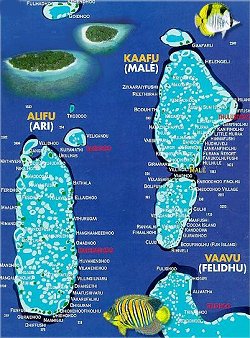
Maldives
Diving the Atolls of the Maldives
The Maldives consist of an extraordinary chain of coral atolls, reefs, channels and submerged pinnacles — thilas — surrounded by the deep waters of the Indian Ocean. During our visits, Hélène and I dived in several of these regions, each with its own character and unforgettable underwater scenery.
North & South Ari Atoll — Alifu Atoll
Ari Atoll is one of the largest atolls in the Maldives, stretching roughly 80 kilometres from north to south and 30 kilometres from east to west. Together with Rasdhoo and Thoddoo Atolls, it forms the administrative region known as Alifu. For divers, this part of the Maldives offers an extraordinary variety of underwater landscapes. There are coral-covered thilas, steep reef walls and deep channels swept by ocean currents. Maaya Thila in North Ari became famous for its abundant marine life, while the waters around Rasdhoo were renowned for early-morning encounters with hammerhead sharks. Farther south, the open waters of Ari became particularly well known for encounters with whale sharks. It was this combination of colourful reefs and the possibility that something very large might suddenly emerge from the blue that made diving here so exciting.
North & South Malé Atoll — Kaafu Atoll
Kaafu Atoll lies near the centre of the Maldivian archipelago and includes North Malé, South Malé, Gaafaru and Kaashidhoo Atolls. These waters contain some of the classic dive sites of the Maldives: channels filled with fish, coral gardens, manta cleaning and feeding areas, dramatic reef formations and wrecks. Strong currents bring nutrient-rich ocean water into the atolls and with it an astonishing abundance of marine life. Among the best-known wrecks is the Maldives Victory, which sank near Hulhulé in 1981 and subsequently became an artificial reef and a celebrated dive site. It was also in this region that we experienced the unforgettable shark feeding at Lion’s Head in the Vaadhoo Channel in 1984.
Vaavu Atoll — Felidhoo Atoll
Farther south lies Vaavu Atoll, traditionally also known as Felidhoo Atoll. More isolated and less developed than the central tourist atolls, it offered a different kind of diving experience. Its eastern side is bordered by a remarkably long reef, broken by channels through which powerful ocean currents flow. These channels create ideal conditions for encounters with larger marine animals, particularly grey reef sharks, eagle rays and other pelagic species. One of its most celebrated sites is Fotteyo Kandu, famous for its dramatic underwater topography, overhangs, caves, colourful soft corals and abundant fish life. For us, however, Vaavu will always be associated with one very special memory: that early morning in August 1993, descending into the dark blue water and waiting at depth until, finally, the unmistakable silhouette of a hammerhead shark emerged from below.
That was the Maldives we loved: beautiful reefs beneath us,
endless blue around us — and never knowing what might appear out of the deep.
That was the Maldives we loved: beautiful reefs beneath us, endless blue around us — and never knowing what might appear out of the deep. Those were the days — the eighties and early nineties, when every dive was an adventure. Sadly, much has changed since then. Over the past three decades, many of the Maldivian reefs have suffered serious deterioration, affected by repeated coral-bleaching events linked to rising ocean temperatures, as well as the growing pressures of tourism and coastal development. Some reefs have shown remarkable resilience and recovery, but the underwater world we remember from those early years can no longer be taken for granted.
It makes those memories all the more precious — and reminds us how important it is to protect what remains.
Source Wikipedia:
Hammerhead photo (Author Barry Peter) licensed under the Creative Commons Attribution 2.0 Generic license.

