


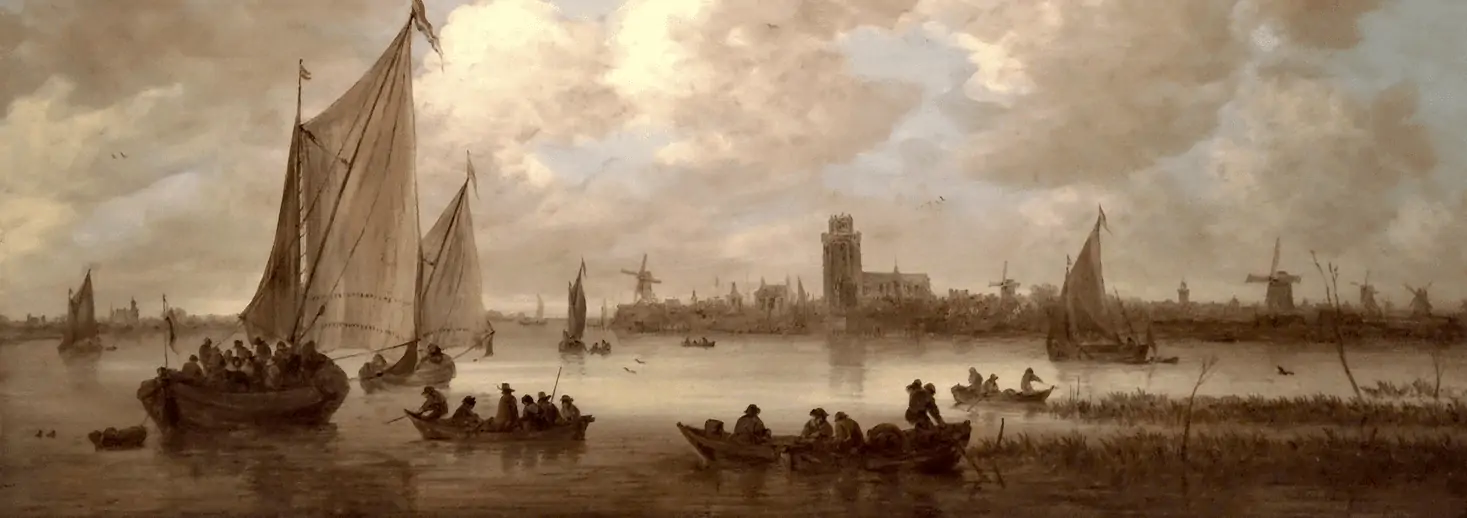
Jan van Goyen, shows seventeenth-century Dordrecht as seen from the River Meuse.
The Story Behind My Kloosterman Research
The painting above, shows seventeenth-century Dordrecht as seen from the River Meuse. I was born here in 1949 and returned to the city in 1998. Today I live near the Grote Kerk, in the heart of Dordrecht’s historic centre. I had known for many years that the Kloosterman family originated in Zeeland, but as time passed — and I grew older myself — I became increasingly curious about my family history.
My father, Adriaan Kloosterman (1917–1977), was born in Vlissingen, as was his father. One day he found an old photograph commemorating the 50th wedding anniversary on 31-05-1938of my great-grandparents, Jan Kloosterman and Jannetje Slabbekoorn . My great-grandmother is still wearing the traditional Zuid-Beveland costume, with its large, stiffly starched hat and the large gold square “kissers” worn at the temples.. On the back were the dates of their marriage and births.
That photograph became the starting point of my genealogical journey.
Together with my father, I visited the archives in Middelburg and began tracing the Kloosterman family back through the generations. After my father died, I continued the research myself. What began with one old family photograph gradually developed into a much larger investigation into the history of the Kloosterman family in Zeeland and beyond.
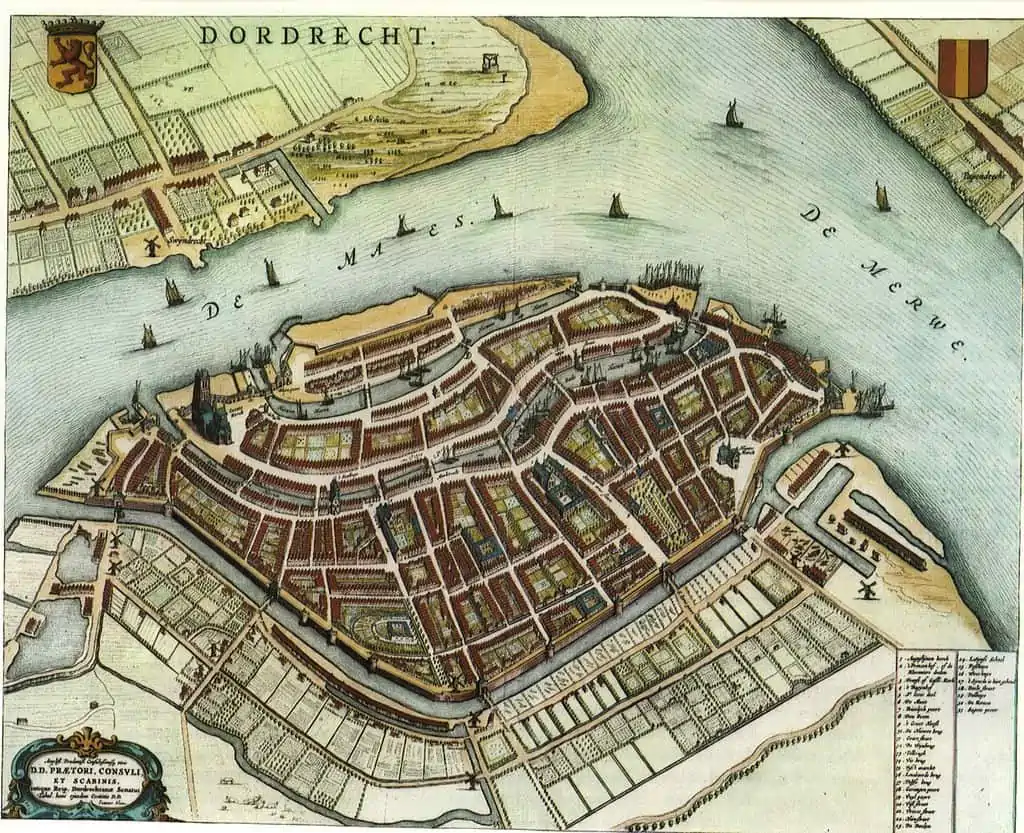
Map of Dordrecht from the atlas of Bleau, 1652.
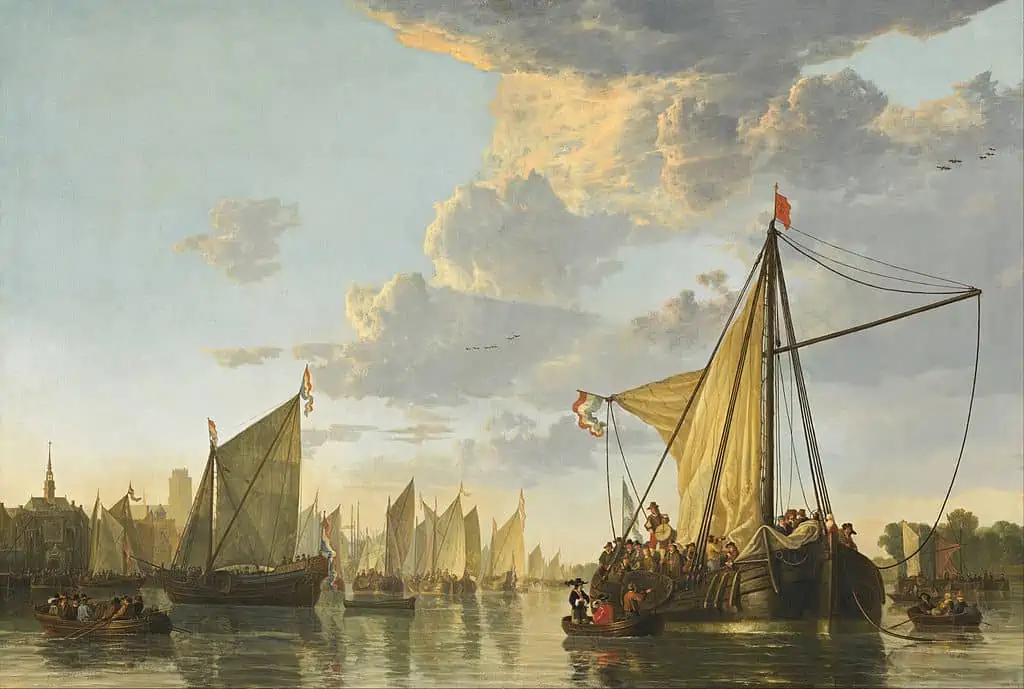
The Maas at Dordrecht, circa 160. Aelbert Cuyp (1620-1691).

Jacob van Deventer (1505-1575) Zelandicarum.
Acknowledgements
Genealogical research is rarely a solitary undertaking, and over the years I have been fortunate to receive help from many people. I am particularly grateful to the staff of the archives in Middelburg and to the researchers and fellow genealogists who shared information, archival references and family material with me. Their knowledge and generosity helped me follow trails that I might otherwise never have discovered.
Working backwards from my great-grandparents, I was able to trace the family to Jan Kloosterman (born 27 April 1859) and his father Leendert Kloosterman (born 29 March 1824). At that point, I could connect my own family branch to the already established genealogy of the Kloosterman family. The Kloosterman Genealogy was also published in print. A second edition is preserved in the Zeeland Archives in Middelburg, in the collection of Zeeland genealogies under number 745. I later decided to make the genealogy available on the internet as well.
I am especially indebted to Mr. M.J. Karman of Middelburg, whose assistance helped put me on the right track in the early stages of my research, and to Mr. Jos Kiser for his valuable contribution. Another important contact was Cees Kaiser of Schoonhoven. I discovered that a substantial part of the existing Kloosterman genealogy was based on research that had originally come from him. He kindly gave me permission to publish this information on my website and generously provided me with additional material from his own research. Through Cees Kaiser I subsequently came into contact with Mrs. S.H.P. Hofman-Bos of Goes, whose research provided much of the information concerning the emigration of members of the Kloosterman family to America. We spoke on the telephone many times, and she too generously gave me permission to use and publish her research.
Without the cooperation and contributions of these people, much of the Kloosterman family history
presented on this website could never have been brought together.
To all of them, my sincere thanks.
From Zeeland to America
Publishing the genealogy online opened an entirely new chapter in my research. Through this website I came into contact with Kloosterman descendants in the United States and Canada, many of whom shared family records, photographs and personal stories with me. What had started with an old family photograph and visits to the archives in Middelburg gradually grew into something I had never anticipated: an international network of family connections.
These contacts enabled me to expand the story of the Kloosterman families who had left the Netherlands and crossed the Atlantic. Names and dates in old records became people again — people who had left Zeeland, built new lives in America and whose descendants, generations later, were now contacting me from across the ocean. In this way, genealogy became much more than the reconstruction of names, dates and relationships from old documents. It also became a way of reconnecting branches of a family that history and migration had separated across continents. And so a genealogical journey that began in Zeeland eventually led across the Atlantic — from Zeeland to America.

My great-grandfather Jan Kloosterman and his wife Jannetje Slabbekoorn at their 50e wedding anniversary 31-05-1938.
My Great-Grandparents
My great-grandfather, Jan Kloosterman, was born in Heinkenszand on 26 April 1859. On 31 May 1878, he married Jannetje Slabbekoorn, who was born on 7 March 1859. Jan spent his working life with the Dutch railways, where he worked as a signalman.
On the left is a photograph of my great-grandparents taken on the occasion of their 50th wedding anniversary. Jannetje is wearing the traditional costume of Zuid-Beveland in Zeeland, with its distinctive large, stiffly starched headdress and the characteristic large square gold ornaments worn at the temples.
Jannetje died on 26 March 1931. Jan lived on until 13 April 1944, during the German occupation of the Netherlands in the Second World War. He therefore died shortly before the notorious Hunger Winter of 1944–1945.
Jan and Jannetje had six children: four sons — Jan, Cornelis, Hendrik and Leendert — and two daughters, Marie and Anna.
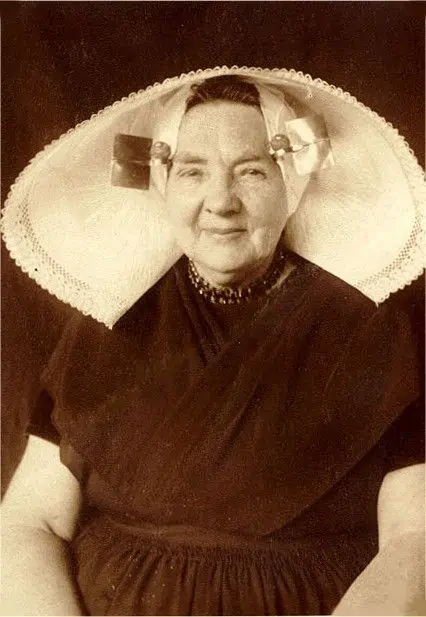
Jannetje Slabbekoorn, born March 7 1857 in Heinkenszand.
My Grandparents
My grandfather Cornelis Kloosterman was their second son. He was born in Vlissingen on 9 February 1893 and died in Dordrecht on 1 August 1972. He married Johanna Bosselaar, who was born in Souburg on 8 August 1892 , the daughter of Adriaan Bosselaar and Willemina Wielemaker. Johanna died in Dordrecht on 6 July 1992. They had two sons, both born in Vlissingen: Jan, born on 21 August 1913, and my father Adriaan, born on 18 December 1918.
Adriaan Bosselaar was something of the “black sheep” of the Bosselaar family. He had been expected to become a minister, but chose a very different life and went to sea instead. Among other vessels, he sailed on the packet boat operating between Vlissingen and Breskens. In his later years, after being widowed — he married twice during his lifetime — he rented rooms in the home of the German Eckhart family in the Lampsestraat in Vlissingen.
Kees had four brothers: Leendert, Johannes, Jan and Hendrik. Two other sons, both also named Cornelis, had died at a young age before Kees was born. He also had two sisters, Marie and Anna; another sister, Maria Catharina, had died at the age of four. Kees’s father, Jan Kloosterman, moved with his family from Heinkenszand to Vlissingen on 10 October 1883. Over the years, the family lived at several addresses in Vlissingen, including Dokkade 122, Kalkhokstraat 132 and Scheldestraat 20, and later on the Nieuwendijk, above a photographer’s studio. The street in which Kees himself was born is not known.
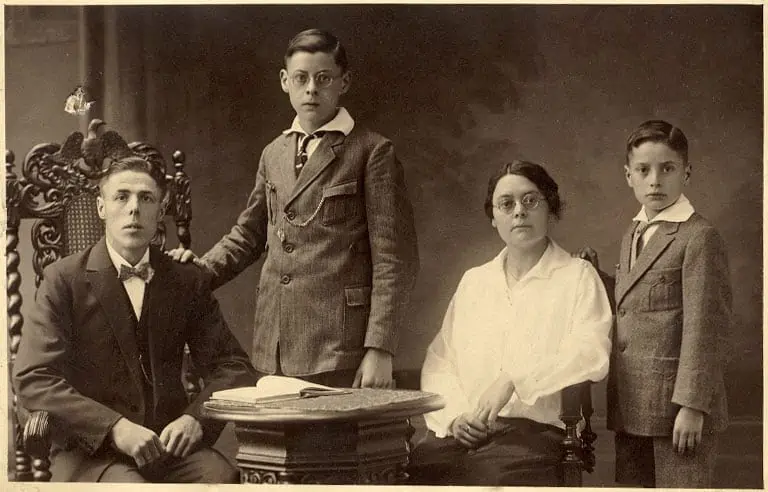
My grandfather (Kees) and grandmother (Anna) and their sons Jan (left) and Adriaan (my father) on the right. The picture was taken around 1929.
A Different Life Than He Had Imagined
As a young man, Kees had hoped to join the Royal Netherlands Navy and travel to the Dutch East Indies. His eldest brother Leendert served there as a sergeant-major in the Navy. Another brother, Johannes, had also left for the East Indies but tragically drowned there. After losing one son so far from home, Kees’s parents did not want another son to follow the same path. Kees therefore remained in Vlissingen. My father Adriaan could still remember visiting the family on the Nieuwendijk in Vlissingen and seeing the fish market there. Fishermen from the nearby village of Arnemuiden would loudly advertise their catch, calling out:
“Wie wil er nog een goeieeee?”
“Who wants another good one?”
It was one of those small memories of old Vlissingen that remained with him throughout his life. Kees began working at a very young age in various shipyards. One of his first jobs was as a riveter’s boy (klinknageljongen), a physically demanding and dirty job from the days when ships were still assembled with red-hot rivets.
He would hold the glowing rivets firmly in position against the hull of the ship while his workmate, on the other side of the steel plate, hammered them flat with a heavy riveting hammer. The work was hot, noisy and exhausting, but it was part of the everyday reality of shipbuilding in Vlissingen at the beginning of the twentieth century.Among the shipyards where Kees worked was the famous De Schelde shipyard in Vlissingen, for generations one of the most important employers in the city.
During the difficult years of the Great Depression, the family left Zeeland and moved from Vlissingen to Dordrecht. That move would eventually establish the Dordrecht branch of the family into which I was born in 1949.
The Kloosterman Name Lives On
I was born in Dordrecht on 19 September 1949 and was named after my grandfather Cornelis — Cees being the familiar Dutch form of Cornelis. It is fascinating to see how the name Cornelis recurs through the generations of my family and can be traced back as far as Cornelis Janszoon Op ’t Clooster, recorded in 1571. I am rather proud to carry a name that has travelled through my family for so many centuries.
The family name itself takes us even further into the history of Zeeland. On the following pages you can read more about the origins and development of the Kloosterman name and its connection with the land on which a cloister once stood.
Even today, the location of that former cloister can still be identified. Remains of the building have been found in the soil, including distinctive bricks with traces of green glazing. Nearby is a farm still known as the Kloosterhoeve, which was occupied by members of the Kloosterman family for periods of time. During the sixteenth and seventeenth centuries, the land on which the cloister had once stood continued to be referred to as “Den Houck daer ’t Clooster in staet” — roughly, “the land where the cloister stands.” Later the area became known as Cloosterland. The people associated with or living on this land came to be identified by the name Cloosterman, which eventually developed into the family name Kloosterman.
Of course, there were many monasteries and convents throughout the Netherlands, and not every family bearing the name Kloosterman today necessarily shares its origins with the Zeeland branch. In this particular family line, however, the connection between Cloosterland and the Kloosterman name can be followed through the historical records.The name Cloosterland itself disappeared from the records around 1625, but by then the family name had taken root. The landscape changed, generations came and went, and members of the family eventually travelled far beyond Zeeland — even across the Atlantic to America.
But the name survived. More than four centuries later, it still lives on — as it does in me.
If you have any additional information about the Kloosterman family or the origins of the family name,
I would be very grateful if you would send me your findings.
Thank you!
Cees
** If you would like to see some more old family pictures, click here.

